22/10/2026 05:21
Fit Question or Stock Enquiry? Telegram Topics for Cambodian Bicycle-Parts Shops

A bicycle-parts promotion can attract questions that need very different answers. One customer wants to identify a brake pad, another asks whether a replacement is available, and a third needs help understanding an installation demonstration. When everything arrives in one conversation, staff can answer the stock question while overlooking the unresolved fit question. For a Cambodian shop serving both nearby riders and customers arranging provincial delivery, that confusion can continue into the order. Telegram topics offer a practical way to organize these discussions. This guide explains how to build a small, understandable topic structure, test it before promotion, and keep SMM panel activity separate from evidence of customer demand.
1. Decide whether topics solve your actual problem
Start by reviewing recent enquiries and identifying where conversations become difficult to follow. Topics are useful when several recurring discussions overlap and customers benefit from reading earlier answers. They add less value when the group receives occasional questions that one person can comfortably handle. Creating more destinations also creates more places staff must check.
Consider a hypothetical bicycle-parts shop in Battambang. Its group receives photos of worn components, questions about available quantities and requests for fitting demonstrations. These are three distinct tasks, even when they concern the same product. A topic structure can make the next step clearer. If almost every exchange instead involves an individual quotation and delivery address, improve the private enquiry process before expanding the public group.
2. Enable topics and understand what they provide
Telegram’s official topic-tabs announcement states that topics can be enabled in any group through Group Settings > Topics. Its original topics documentation explains that topics work as separate conversations within a group, with their own shared media and notification settings. Administrators can also control who creates and manages topics through permissions. These are organizational features; they do not establish product compatibility or confirm orders.
Have the owner or an authorized administrator review the settings in the app actually used by the shop. Initially, let designated staff manage the structure so customers do not create competing spaces for every variation of a question. Test the result with an ordinary member account. A layout that looks obvious to the administrator may still leave a newcomer unsure where to start.
3. Use three customer tasks as your starting structure
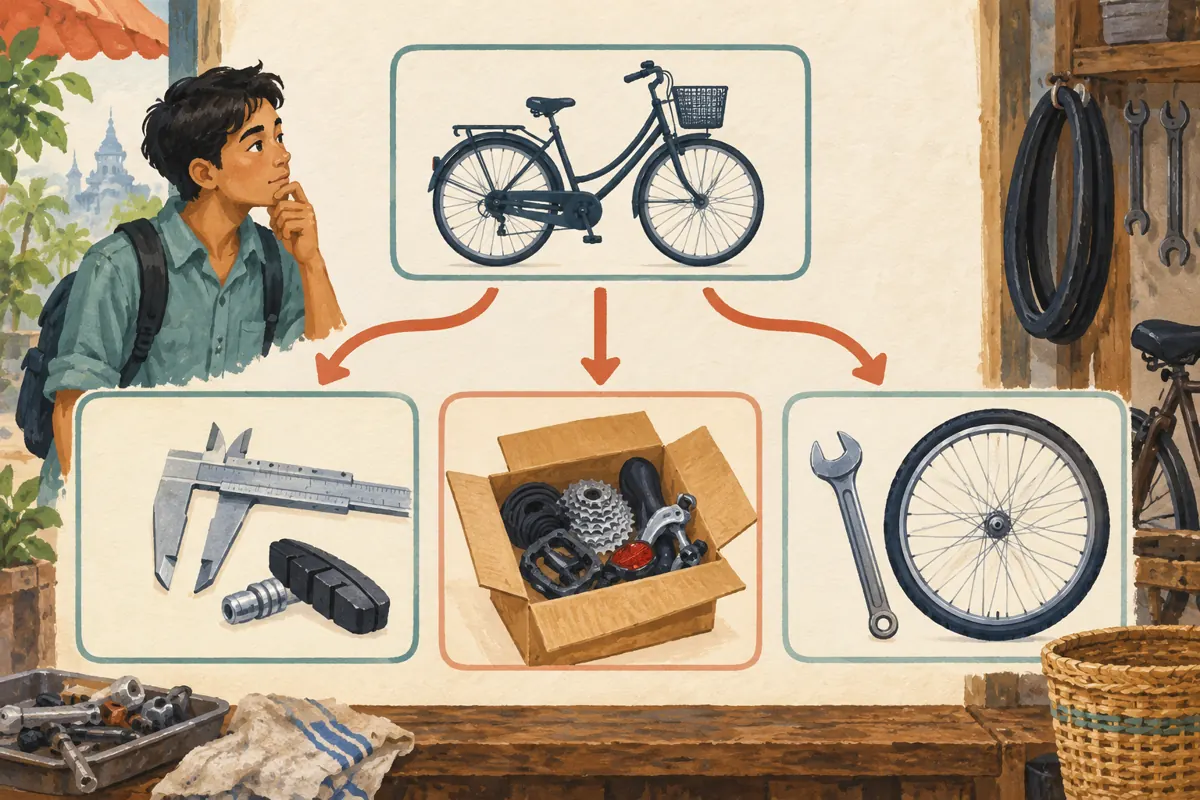
For the hypothetical shop, start with Fit Questions, Stock Enquiries and Installation Guides. Fit Questions collects requests to identify a component or clarify which information is missing. Stock Enquiries covers availability after a product has been identified. Installation Guides holds explanations of the shop’s demonstrations and questions that staff can responsibly answer. These names describe what customers want to do.
Avoid organizing immediately by every brand, wheel size and product family. Customers who cannot identify a part may also be unable to choose its category. Use the language your customers understand, with a staff-reviewed Khmer equivalent where appropriate, and preserve genuine model names accurately. Add another topic only when a recurring discussion has a distinct purpose and someone is responsible for maintaining it.
4. Give each topic a short working brief
Write an introductory message for each topic explaining its purpose, the information to provide and the next step. Telegram supports pinned messages within topics, so a short instruction can remain easy to locate. Keep it focused enough to read on a phone while standing beside a bicycle. A lengthy catalogue pasted into every topic makes the starting point harder to recognize.
For Fit Questions, a hypothetical instruction could request the component name if known, a clear photograph, any visible model marking and the specific uncertainty. Stock Enquiries could request the confirmed product reference and quantity. Installation Guides could ask which demonstration and which step needs clarification. Include a simple instruction for customers who are unsure: start with the fit topic, and staff will help identify the appropriate next step.
5. Make the first fit enquiry useful
Prepare an example using a shop-owned component. Show a clear overall photograph and a close view of the mounting shape or model marking. If dimensions are relevant, ask the customer to state both the value and unit, and explain exactly which points should be measured. A photograph beside a ruler can provide context, but perspective can make it unsuitable for confirming a precise dimension.
In a hypothetical exchange, a buyer posts two similar-looking brake pads and asks which one to order. Staff should identify the missing information before offering a product. A useful response might request the brake model or a clearer mounting view. Avoid declaring compatibility from appearance alone. For a safety-critical component, unresolved uncertainty should lead to a suitable in-person assessment rather than a confident guess made to complete the sale.
6. Move from identification to stock without losing context
Once staff identify the requested product, give the customer a concise reference that can accompany the stock question. It might contain the shop’s product code, the agreed variant and any remaining qualification. Ask the customer to carry that reference into the next exchange. This reduces the chance that a second employee interprets a fresh photograph as a different part.
Treat availability as a separate check. A correct identification does not mean the item is on the shelf, reserved or ready for dispatch. In the hypothetical shop, the stock reply would distinguish available stock from an item awaiting confirmation. If staff quote a price, state the currency, quantity basis and included items. Keep delivery arrangements and any reservation decision explicit instead of allowing a public stock reply to imply a completed order.
7. Keep personal order details out of shared topics
Use public discussion for information that other customers can reasonably learn from. Move phone numbers, addresses, payment references and individual order problems into the shop’s designated private contact route. Do not create a topic called Private Orders and assume its name limits access. A topic is an organizational space inside the group, not a substitute for checking who can see a conversation.
Explain the handoff before requesting personal details. For example, tell a customer to contact the named shop account with the agreed product reference and quantity. Staff can then collect the delivery information needed for that order. If a useful public answer emerges from the exchange, rewrite it without personal details and obtain permission before reusing customer photographs. Keep the public explanation independent of the customer’s transaction.

8. Test the route before promoting the group
Ask a colleague who did not build the structure to complete a realistic enquiry. Give them a shop-owned sample photograph and ask where they would post it, what information they would include and how they would proceed after identification. Observe the first choice rather than explaining the correct answer immediately. Their hesitation can reveal unclear topic names or an instruction that assumes too much product knowledge.
Test the actual invitation or public link intended for promotion, including any membership step. Confirm that the person reaches the intended group and can find the starting guidance. Then review the promotional caption. A promise such as help identifying which details to photograph should lead to that assistance. Avoid promising immediate fitting advice when staff only check the group during stated working periods.
9. Assess SMM services against this workflow
The supplied catalogue includes the exact public service name “Telegram Reactions + Free Views | Alien monster 👾| [ Max 1M ] | Day 100K”. The title identifies a reactions-and-views offering, but its description is empty. Treat the wording as a catalogue label, not verified evidence of delivery speed, audience origin or customer quality. It does not establish that the service can target a group topic or assist with enquiry routing.
Before considering any panel request, check the current service requirements, supported destination and applicable platform rules. If compatibility with the intended destination is unclear, do not submit a speculative order. Purchasing engagement does not organize topics or supply informed answers. It is also not evidence of genuine interest, sales, advertising delivery or Cambodian users. Keep any service delivery record separate from the shop’s enquiry and order records.
10. Moderate for clarity and review real outcomes
Assign a primary responder and a backup for each active topic. When someone posts in the wrong place, provide a brief, friendly direction and preserve the useful context. Repeatedly copying an entire question across several topics creates competing answers. If customers consistently choose the wrong destination, reconsider the label before treating the issue as customer carelessness.
Review whether enquiries contain enough information, whether staff request the same missing detail repeatedly and whether customers reach an appropriate next step. Record these observations without inventing conversion claims. A recurring mounting-shape question may justify a new demonstration; a quiet topic may need to be combined with another. Keep unresolved questions visible to staff, and distinguish an answered question from a confirmed purchase. The structure should reduce confusion enough to justify the attention it requires.

Frequently asked questions
Does a small Cambodian shop need a large group before enabling topics?
No. Telegram’s official June 2025 announcement says topics can be enabled in any group. The practical decision is whether the structure helps customers and staff. A small group with several overlapping technical discussions may benefit, while a larger group used mainly for occasional announcements may not. Test a limited structure and keep it only if people can navigate it.
Should every bicycle component have its own topic?
Usually, start with customer tasks rather than a complete inventory hierarchy. A person holding an unfamiliar part may not know its product category. Broad destinations for fit, stock and installation questions give that person somewhere understandable to begin. Split a topic later when repeated enquiries make the distinction useful and staff have capacity to maintain both spaces.
What if a customer posts a stock question before the part is identified?
Ask for the missing identification details before confirming availability for a specific item. Explain what is needed in one concise reply, such as the model marking and mounting view. Once the product reference is agreed, carry it into the stock check. Do not let a photograph of a similar component become an implicit promise that the replacement will fit.
Can a topic serve as a private customer order room?
Do not rely on a topic name to create privacy. Treat shared group topics as spaces for information suitable for their members. Direct individual order details to the shop’s designated private contact route, and collect only what the transaction requires. Public guidance can explain the handoff without displaying a customer’s address, payment evidence or telephone number.
Can an SMM panel make the topics look active while staff prepare answers?
Purchased activity cannot substitute for a useful discussion or a staffed enquiry process. It should not be presented as customer approval, local demand or proof that the shop has resolved questions. Prepare the instructions and response responsibilities first. If a service is considered later, verify its supported destination and keep its delivery records distinct from genuine customer interactions.
How should the shop judge whether topics are worth keeping?
Look for observable improvements in the work: customers choose an appropriate starting point, provide clearer product information and receive consistent next steps. Also note missed messages and extra moderation effort. If the structure creates more searching than clarity, simplify it. Useful evidence comes from actual enquiries and confirmed transactions, with their limitations recorded, rather than from the appearance of a busy group.
Explore the current service catalogue, create an account, or ask a specific question through support tickets.
- Telegram: Topics in Groups, Collectible Usernames, Voice-to-Text for Video Messages and More
- Telegram: Direct Messages for Channels, Voice Trimming, Topic Tabs and HD Photos
Prepared with AI assistance. Illustrations explain the workflow and do not represent customer results.